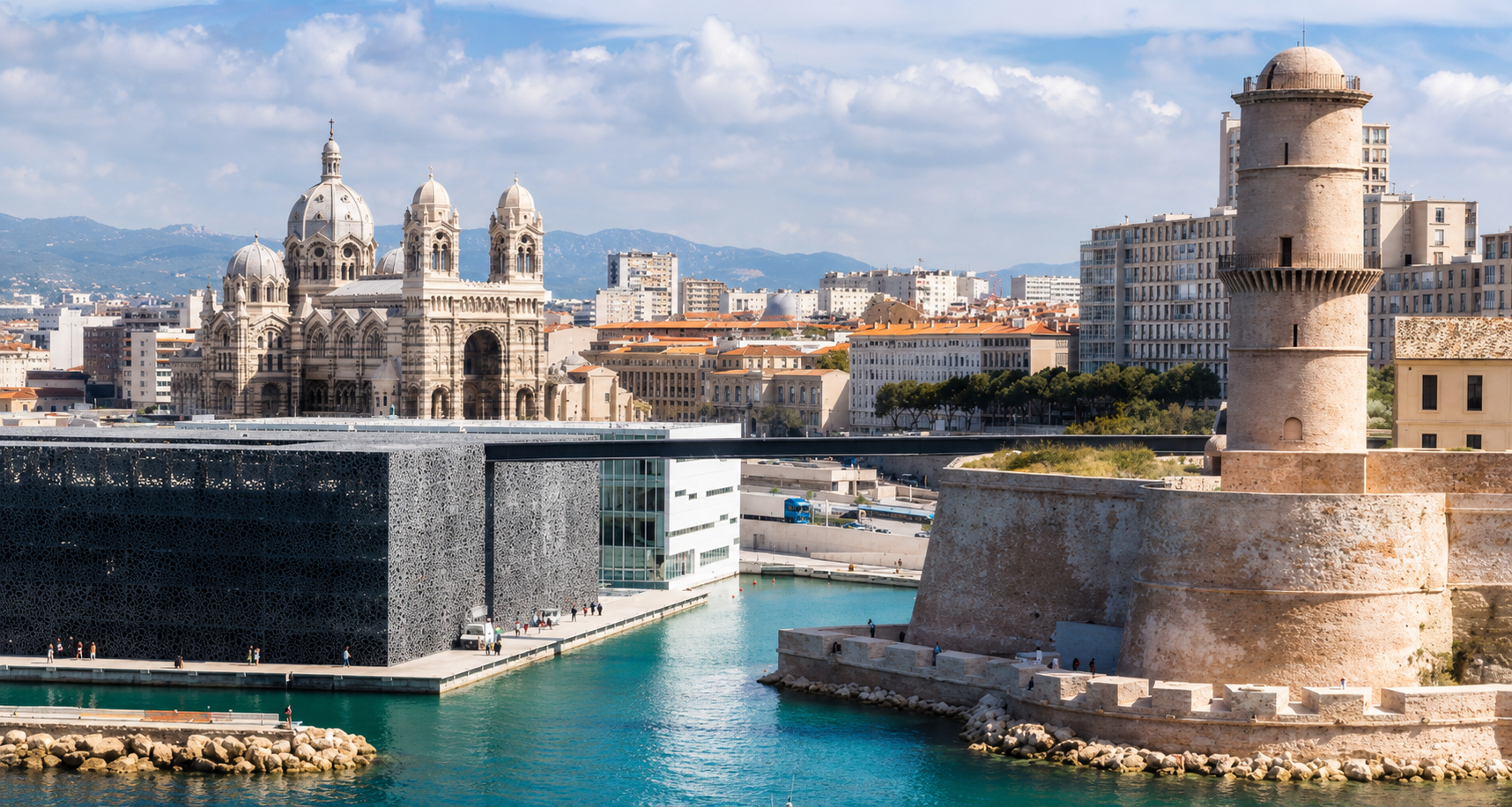
This architectural landmark has become one of Marseille’s most iconic sights. But the Mucem is much more than just a spectacular building. Its collections tell the stories of Mediterranean cultures, their interactions, their traditions, and the sometimes complex histories that connect the two shores.
To really explore it, it’s best to take your time. The tour begins in front of the J4, continues through the museum galleries, crosses Fort Saint-Jean, and can naturally end in the streets of Le Panier.
A museum to help you understand the Mediterranean
Opened in June 2013, the Museum of European and Mediterranean Civilizations is, among other things, the successor to the National Museum of Popular Arts and Traditions and to part of the European collections of the Museum of Mankind.
Its collections include more than 350,000 objects, in addition to photographs, archival materials, books, and numerous documents. However, the Mucem does not present a linear history of the Mediterranean.
He prefers to create a dialogue between different eras and cultures. An ancient ceramic piece might be displayed alongside a traditional costume, a contemporary photograph, or an everyday object. The exhibitions thus explore beliefs, migration, food, crafts, identities, and colonial heritage.
This diversity is what makes the museum unique: it portrays the Mediterranean as a living space that has always been shaped by travel and exchange.
First, there's the building
The main building, known as J4, was designed by Rudy Ricciotti in collaboration with architect Roland Carta. It forms a perfect square with sides measuring 72 meters, surrounded by a lattice of high-performance fiber-reinforced concrete.
Depending on the time of day, this envelope filters the light, casts shadows onto the walkways, and reveals glimpses of the sea. Outside the rooms, two ramps lead gradually up to the rooftop terrace.
The promenade offers several views of Fort Saint-Jean, the Palais du Pharo, the entrance to the Old Port, and the open sea. These outdoor areas are freely accessible.
Don’t rush through them: they’re an integral part of the tour.The Mucem’s architecture was specifically designed to maintain a constant connection between the museum, Marseille, and the Mediterranean.
Inside: Objects and Stories
The Mucem combines permanent exhibitions with a rotating schedule of temporary exhibitions throughout the year.
For first-time visitors, “Méditerranées” is a good place to start. The exhibition explores how art, travel, museums, and history have shaped our perceptions of the Mediterranean world.
The exhibition “Populaire?” highlights the objects in the museum’s collection. Costumes, handcrafted items, religious objects, and artifacts from daily life illustrate how societies work, celebrate, and pass down their traditions.
The two tours complement each other. “Méditerranées” helps visitors understand the museum’s mission, while “Populaire?” makes the collections feel more immediate and human.
Temporary exhibitions then offer the opportunity to explore a historical, artistic, or contemporary topic in greater depth. Check the Mucem’s schedule before your visit to choose the tour that interests you most.
On the other side of the footbridge
From the roof of J4, an aerial walkway leads directly to Fort Saint-Jean. In just a few steps, the contemporary architecture gives way to the towers, ramparts, and courtyards of a historic military complex.
Long closed to the residents of Marseille, the fort was restored and opened to the public in 2013. Some of the buildings host exhibitions, but the site is also a great place to take a stroll.
The Garden of Migrations features aromatic plants, fruit trees, and various Mediterranean species. It evokes the journeys of plants, their uses, and the traditional knowledge passed down along the shores of the sea.
A second footbridge then leads to Saint-Laurent Church and the Panier district. Since the outdoor areas of Fort Saint-Jean are free to visit, this walk is well worth taking even if you don’t have a ticket for the exhibitions.
The tour we recommend
Start at the J4 esplanade to view the building from the water. Then visit an exhibition, and take the outdoor ramps up to the rooftop terrace.
Cross the footbridge to Fort Saint-Jean and take some time to explore its gardens and ramparts. The second footbridge will lead you to the Panier, where you can continue your day exploring the Vieille Charité, the local workshops, and the neighborhood’s small squares.
You can head back via the Major Cathedral or along the Old Port’s waterfront. Find more suggestions on our page dedicated to tours and activities in Marseille.
The Mucem at the Right Time of Day
The morning is the perfect time to enjoy the exhibits in a quieter atmosphere. In the late afternoon, the shadows cast by the netting grow longer, and the terraces at Fort Saint-Jean are bathed in softer light.
In the summer, save the hottest part of the day for the exhibition halls and save the gardens for the end of the day. If your schedule allows, come back to see the J4 after dark: its facades are then bathed in shades of blue and turquoise.
A Few Things to Know Before Your Visit
The Mucem is located at 7 Promenade Robert Laffont, on the J4 Esplanade, in Marseille’s 2nd arrondissement.
It is open every day except Tuesdays, May 1, and December 25. Hours vary by season, and the footbridges close slightly before the rest of the site.
A single ticket grants access to the exhibitions at J4 and Fort Saint-Jean. The outdoor walkways, gardens, and most of the ramparts remain open to the public free of charge.
From the Vieux-Port or Joliette metro stations, it’s about a ten-minute walk. For schedules and any route changes, check the Mucem’s practical information.
Staying Near the Mucem
Located on Rue Mazenod,the Hôtel du Mucem by Esteem is within walking distance of the museum, Fort Saint-Jean, the Major Cathedral, and the Panier district.
Its rooms, decorated in Mediterranean colors, offer a peaceful place to rest after a day of sightseeing. The luggage storage, breakfast buffet, and 24-hour front desk also make your stay more convenient. You can find more details on the page dedicated to the hotel’s services.
To explore Marseille from its historic district, choose your room at the Hôtel du Mucem by Esteem.
%201.png)